NVIDIA opens up its Vera Rubin rack designs so anyone can build the next AI data centers
At the Open Compute Project summit, NVIDIA contributed its Vera Rubin rack and server tray designs to the open standards group, plus a new rack built for AI agents and a networking standard with Cisco.
By ScoviAI Team
Key points
- Announced at the OCP Global Summit in San Jose in October 2026
- NVIDIA contributed Vera Rubin rack and compute tray designs through its open MGX architecture
- The MGX 1.2 spec supports liquid-cooled racks of up to 250kW
- A new Vera CPU rack is built for AI agents' tool calls and sandboxed tasks
AI data centers are growing from megawatts to gigawatts. Building them faster depends partly on everyone using compatible parts. At the Open Compute Project (OCP) Global Summit in San Jose, NVIDIA made a big contribution to that effort: it opened up the designs for its next-generation Vera Rubin racks.
The Open Compute Project is an industry group, started by Facebook in 2011, where companies share hardware designs for data centers so that anyone can build them.
What NVIDIA contributed
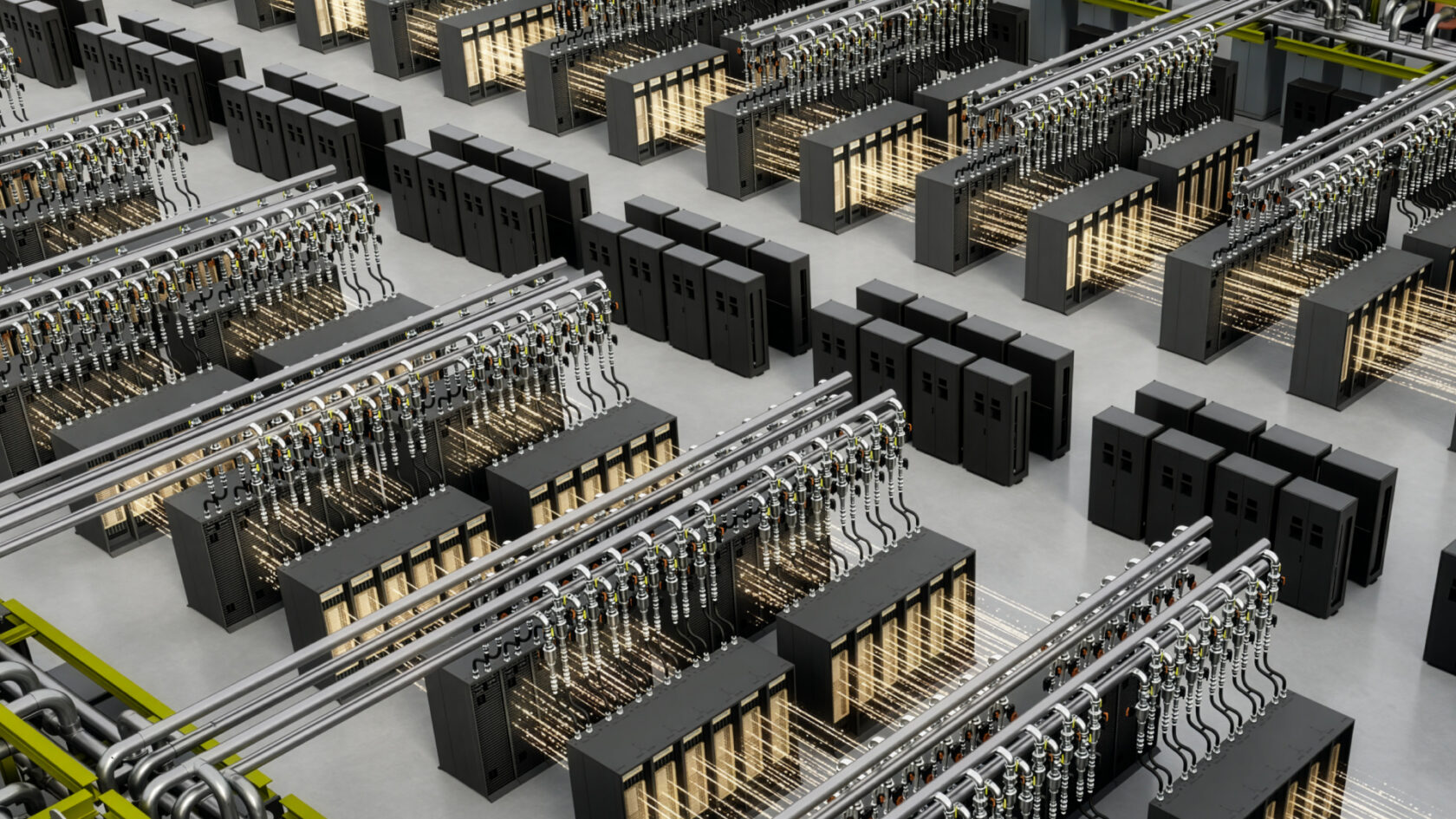
NVIDIA gave OCP key Vera Rubin rack and compute tray designs through its open MGX architecture. System builders can use them as a common starting point instead of designing everything from scratch.
The updated MGX 1.2 specification adds:
- liquid cooling across the whole rack, with connectors that snap in without manual plumbing,
- a liquid-cooled 5,000-amp busbar for higher-power systems,
- support for standard 19-inch equipment and denser racks,
- support for racks drawing up to 250kW,
- fanless, liquid-cooled server trays and standard power and cooling interfaces.
A rack built for AI agents
NVIDIA also published a Vera CPU rack design. Its big Vera Rubin NVL72 systems handle training and running models; the CPU rack is meant for everything around them that AI agents do: tool calling, orchestration and sandboxed execution. It's a sign of how much computing agents need beyond the model itself. NVIDIA's OpenShell blueprint puts agents on these same Vera CPUs.
Other announcements
- NVIDIA and other hyperscale operators published open standards for AI factory design and grid resilience.
- NVIDIA and Cisco announced the USFP standard, which NVIDIA calls the first module for 400Gb/s-per-lane networking.
- NVIDIA and Google announced support for Google's Falcon transport on future NVIDIA network cards.
- Meta and NVIDIA advanced open AI networking with Spectrum-X Ethernet.
Why it matters
The faster data centers get built, the faster AI services can grow, and the more NVIDIA chips get sold. Open designs reduce the custom engineering every builder has to do. They also make NVIDIA's way of building racks the default, which competitors may like less. For a look at how Microsoft is building its own chips instead, see Microsoft's Maia 300.
Sources
ScoviAI Team is the ScoviAI newsroom. We write every article ourselves from the original announcements and link our sources. Spotted a mistake? Tell us and we'll fix it.
ADVERTISEMENT