Free AI API in 2026: Every Free Tier for Developers (Gemini, Groq, Cerebras and More)
ScoviAI TeamUpdated 5 min read
The short answer
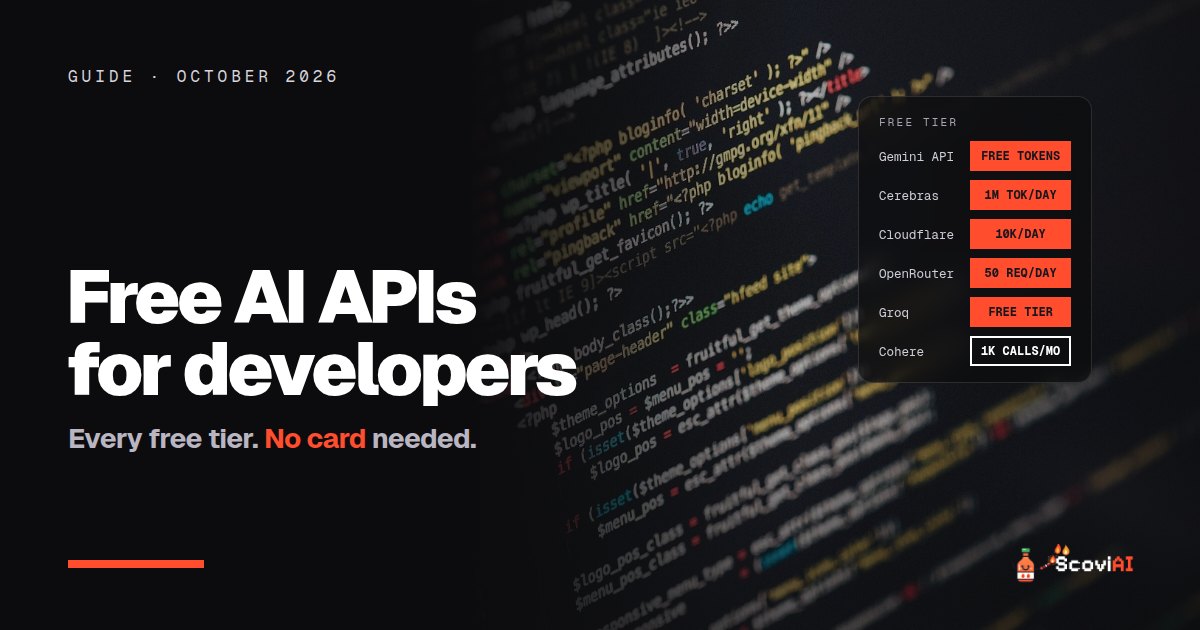
Gemini, Groq, Cerebras and Mistral all offer a free AI API tier with no credit card. Cerebras gives 1 million tokens a day, OpenRouter has free models, and Modal adds $30 of free compute every month.You can build with a free AI API in 2026 without paying a cent: Google's Gemini API, Groq, Cerebras and Mistral all have free tiers for testing, Cerebras gives 1 million free tokens a day, OpenRouter offers free models through one API, and Cloudflare Workers AI includes 10,000 Neurons of free inference every day. For hosting and storage around your app, Modal gives $30 of free compute every month, and Qdrant and Pinecone have free vector databases.
Quick answer: start with the Gemini API free tier or Groq for a chatbot prototype, add OpenRouter if you want to compare many models through one key, and keep Cerebras in mind when you need a lot of free tokens. None of the free tiers are meant for production traffic, so plan to pay once real users arrive.
Free AI API tiers compared (October 2026)
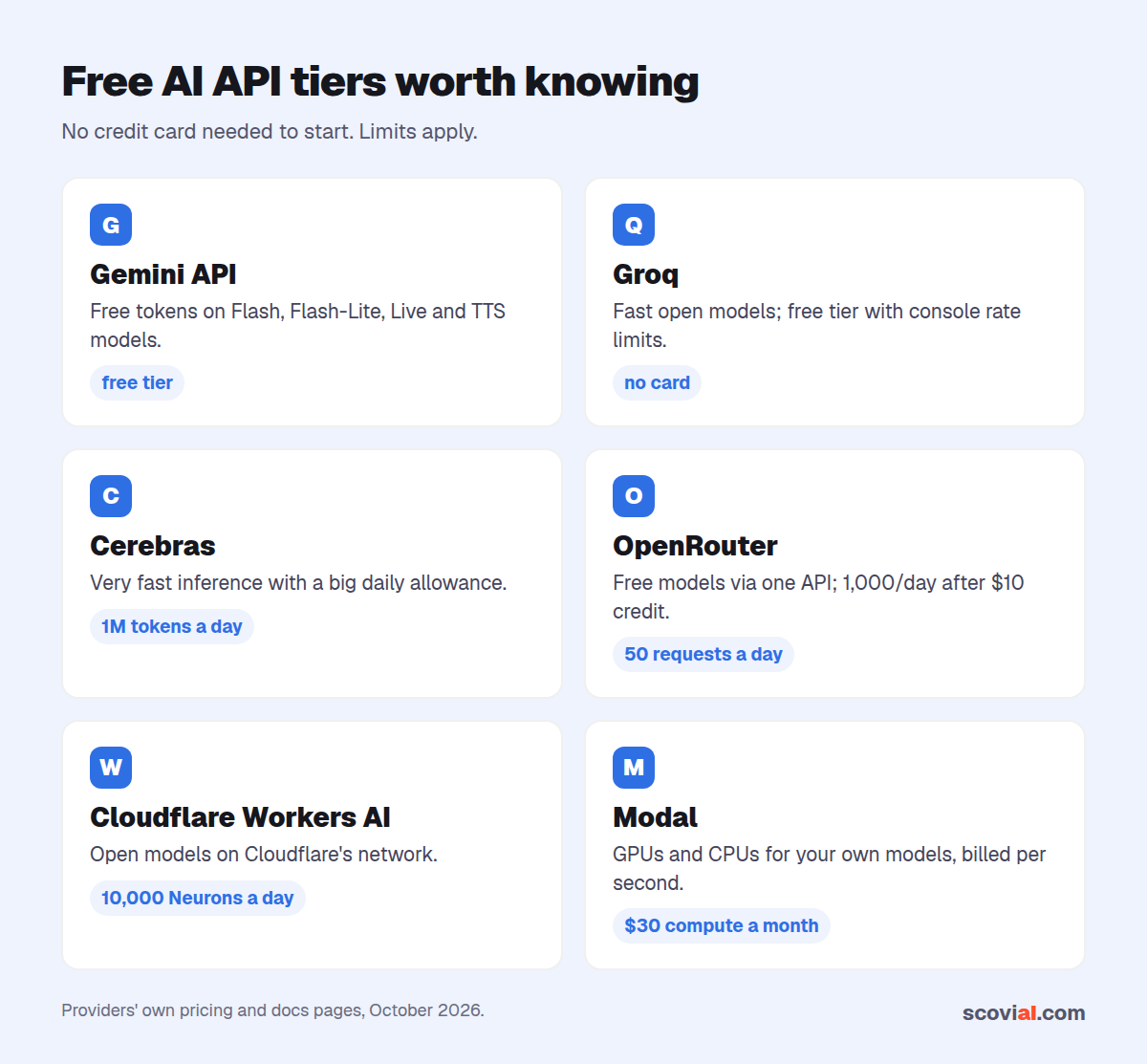
| Provider | What's free | Card needed? | Watch out for |
|---|---|---|---|
| Gemini API | Several Flash, Flash-Lite, Live and TTS models with free tokens | No | Google may use free-tier content to improve its products |
| Groq | Free tier for fast open models | No | Rate limits shown in your console |
| Cerebras | 1 million tokens a day | No | Free trial credits expire after 30 days |
| Mistral AI | Free "Experiment" plan | No | Usage and rate limits |
| OpenRouter | Free models: 20 requests a minute, 50 a day | No | 1,000 a day once you've bought $10 of credits |
| Cloudflare Workers AI | 10,000 Neurons a day | No | Free plan can't go over the daily allowance |
| Cohere | Trial key: 1,000 calls a month | No | Not allowed for production or commercial use |
All of these let you start without a credit card. Limits change often, so check each provider's page before you design around a number.
Gemini API: the easiest free LLM API to start with
The Gemini API free tier covers several of Google's fast models, including Flash and Flash-Lite, plus Live and text-to-speech models, with free input and output tokens. For most prototypes, chatbots and classroom projects, that's enough.
The important fine print: on the free tier, Google may use what you send to improve its products. Don't send customer data or anything confidential until you switch to the paid tier, which doesn't have that condition. See the Gemini API tool page for the latest deals.
ADVERTISEMENT
Groq and Cerebras: free and very fast
Groq runs open models on its own chips, and responses come back unusually quickly. The free tier needs no credit card; adding a payment method moves you to a Developer tier with higher limits. Its API is compatible with the OpenAI SDK, so you can usually switch by changing the base URL.
Cerebras is the other speed specialist. Its free tier includes 1 million tokens a day, one of the most generous daily allowances available. If your app makes many small calls, Cerebras' daily budget goes a long way.
OpenRouter: many free models behind one key
OpenRouter gives you a single API for hundreds of models from different providers, and some of them are free. Free models allow 20 requests a minute and 50 a day. If you buy at least $10 of credits (which don't expire), the free-model limit rises to 1,000 requests a day. That $10 is the best-value upgrade in this list if you're testing seriously.
Mistral, Cloudflare and Cohere
- Mistral AI has a free Experiment plan with API access on by default and no card needed.
- Cloudflare Workers AI gives every account 10,000 Neurons of inference a day on open models, on both free and paid plans. On the free plan you simply stop at the daily limit.
- Cohere creates a trial API key for every new account: 1,000 calls a month, with limits per endpoint such as 20 chat requests a minute. It's handy for testing Cohere's embeddings and reranker, but trial keys can't be used in production.
Free tools around the API: compute, vectors and tracing
A real AI app needs more than a model. These free tiers cover the rest of a small stack:
- Modal: $30 of GPU and CPU compute every month on the Starter plan, with no monthly fee. Great for running open models, batch jobs or fine-tuning experiments.
- Pinecone: a free Starter plan with 2 GB of storage and up to 5 indexes for RAG and search.
- Qdrant Cloud: a free 1 GB cluster with no time limit (it's suspended after a week without use).
- LangSmith: free tracing of up to 5,000 runs a month, so you can see what your agent actually did.
- Google Colab: free notebooks with GPU and TPU access, subject to availability.
Free credits for students and startups
If you qualify, these are worth far more than any free tier:
- Azure for Students: $100 of credit with no credit card, usable for Azure OpenAI.
- Google Cloud: $300 of credit for new customers, which also works for Gemini on Vertex AI.
- Together AI Startup Accelerator: $15,000 to $50,000 in credits for AI startups, depending on funding stage.
- fal Startup Program: $1,000 in generative media credits, growing to $5,000 as you scale.
How to stay on free tiers longer
- Cache answers. Don't send the same prompt twice; store results.
- Use the smallest model that works. Flash-class and small open models are often free or nearly free.
- Spread load across providers. Most SDKs speak the OpenAI format, so switching between Groq, Cerebras and OpenRouter is a config change.
- Set spend limits the moment you add a card. Most consoles let you cap monthly spending.
- Read the data policy. Free tiers sometimes allow training on your inputs; paid tiers usually don't.
Common mistakes with free AI APIs
- Shipping a product on a free tier. Free limits can change without notice, and rate limits will break your app the day it gets popular.
- Sending private data to a free tier whose terms allow the provider to use your inputs.
- Leaking API keys. Never put keys in front-end code or public repositories; keep them on a server.
- Forgetting spend limits after adding a card to unlock higher tiers.
Which free AI API should you choose?
- First chatbot or class project: Gemini API free tier.
- Speed matters: Groq or Cerebras.
- Comparing many models: OpenRouter (and its $10 credit upgrade).
- Running your own model: Modal's $30 a month of compute.
- Building RAG: Pinecone or Qdrant for vectors, plus LangSmith to debug.
When your app gets real users, compare paid prices before committing. We track new developer credits and free tiers in our API & cloud deals.
Sources: Gemini API pricing; Groq billing FAQs; Cerebras rate limits; OpenRouter limits; Cloudflare Workers AI pricing; Cohere rate limits; Modal pricing; Qdrant pricing; LangSmith pricing; checked in October 2026.
ADVERTISEMENT
Frequently asked questions
›Is there a free AI API?
Yes. Google's Gemini API, Groq, Cerebras and Mistral all have free tiers you can use without a credit card, and OpenRouter offers free models through one API. Rate limits apply, and free tiers aren't meant for production.
›Which free AI API has the most tokens?
Among the free tiers we checked, Cerebras is the most generous by tokens, with 1 million free tokens a day. Cloudflare Workers AI gives 10,000 Neurons of free inference every day.
›Is the Gemini API free?
Yes, the Gemini API has a free tier for several Flash, Flash-Lite, Live and text-to-speech models. On the free tier Google may use your content to improve its products; the paid tier doesn't have that condition.
›Can I use a free AI API in production?
It's not recommended. Free tiers have rate limits that can change, some (like Cohere's trial key) forbid production use, and some allow the provider to use your inputs. Move to a paid tier before launch.
›Are there free AI credits for students and startups?
Yes. Azure for Students gives $100 of credit with no card, Google Cloud offers $300 to new customers, and startups can apply for programs like Together AI's accelerator (up to $50,000) and fal's Startup Program (up to $5,000).
Written by the ScoviAI team. We check prices on each seller's own pricing page and update our guides when plans change. Some links may be affiliate links; they never change our verdicts. How we work
Live deals for the tools in this guide
Gemini API free tier: Flash models with free input and output tokens
Google Gemini API · API & Cloud Credits ·
Cloudflare Workers AI: 10,000 Neurons of inference free every day
Cloudflare Workers AI · API & Cloud Credits ·